Hidden Halo Cushion Engagement Rings
What defines a hidden halo cushion engagement ring?
A hidden halo cushion ring places a pavé-set band of small diamonds beneath the girdle of the cushion-cut centre stone rather than around its crown — so the halo is concealed when viewed from directly above. From the side and at an angle, those accent diamonds catch the light and appear to float the cushion stone upward. The cushion cut's rounded corners and larger facets complement this placement particularly well: the stone's own soft outline reads clean from above, while the hidden halo adds perceived diameter and depth from every other viewing angle. It is a combination chosen when the preference is for a quietly detailed ring that looks more substantial than its centre-stone carat weight alone would suggest.
How does the hidden halo interact with a cushion cut specifically?
The hidden halo's effect depends on the interplay between the halo's placement and the centre stone's outline. With a cushion cut — which typically runs between a 1.00 and 1.10 length-to-width ratio for a square cushion, or up to 1.20 for a more rectangular form — the curved corners allow the hidden halo band to follow the stone's silhouette closely without the sharp-corner risk that emerald or princess cuts carry. The cushion's larger crown facets also tend to reflect light broadly, so the accent diamonds beneath reinforce rather than compete with the centre stone's own spread. A round brilliant in a hidden halo setting produces a similar effect, but the cushion's softer geometry creates a warmer, slightly more vintage character at the crown.
Which metal suits a hidden halo cushion ring?
Metal choice for a hidden halo cushion ring affects both the accent-diamond setting and the overall colour impression of the stone. Platinum and white gold keep the hidden halo's accent diamonds near-colourless in appearance, which maximises the brightness around the cushion's girdle. Rose gold or yellow gold in 9ct, 14ct or 18ct introduces warm reflection into the hidden halo channel, which can flatter cushion cuts graded in the G-to-J colour range by complementing, rather than contrasting, their slight warmth. The hidden halo's intricate pavé work is well-suited to platinum's density and hardness, which reduces the risk of accent-stone loss over time — a practical consideration given how closely those diamonds are set beneath the centre stone.
What does a hidden halo cushion engagement ring cost in the UK?
Price is driven by the carat weight and grade of the cushion-cut centre stone, the number and quality of the accent diamonds in the hidden halo, and the chosen metal. Cushion cuts are generally priced below round brilliants of equivalent carat weight, which can allow a larger or better-graded stone within a given budget. The hidden halo setting adds more labour and material than a plain solitaire but typically less than a full double-halo. Bridebook's US average engagement ring spend of $6,000 provides a baseline; many hidden halo cushion rings fall above this figure once a 1.0ct-plus certified cushion is factored in, though well-proportioned 0.5ct to 0.75ct cushion options are available at more modest investment levels.
How long does a hidden halo cushion ring take to make?
A hidden halo cushion engagement ring is made to order from our Hatton Garden workshop. The process moves from consultation through CAD design to a silver or wax sample, which can be brought to our showroom for a try-on before the final ring is cast. From order confirmation, allow 7 to 14 business days depending on design complexity — the hidden halo's closely set accent pavé sits toward the longer end of that range. Once finished and polished, every ring is hallmarked at the London Assay Office before insured UK delivery. Resizing is complimentary for life, and returns are accepted within 30 days, excluding custom and bespoke orders.
Frequently asked questions
What is a hidden halo cushion engagement ring?
A hidden halo cushion engagement ring features a cushion-cut centre stone lifted above a band of pavé-set accent diamonds positioned just below its girdle. The halo is not visible from directly above, giving the ring a cleaner profile from the top while adding brightness and apparent size when viewed from the side or at an angle.
Is a hidden halo setting suitable for daily wear?
Yes, provided the accent diamonds are well-set. Platinum and 18ct gold settings hold the hidden halo's closely spaced stones securely. The girdle-level position of the halo means it is slightly less exposed to direct knocks than a raised crown halo, though as with all pavé work, periodic checks by a jeweller are advisable.
What length-to-width ratio works best for a cushion hidden halo ring?
A ratio between 1.00 and 1.08 produces a square cushion that sits symmetrically within the hidden halo band. Ratios from 1.10 to 1.20 give a softer rectangular outline. Both proportions work well with the hidden halo style; personal preference for square versus slightly elongated is the deciding factor.
Can I choose a lab-grown cushion diamond for a hidden halo ring?
Lab-grown cushion diamonds are fully available and certified to the same standards — GIA, IGI, or HRD — as natural stones. They often allow a larger carat weight or higher colour and clarity grade within the same budget. Both natural and lab-grown options are offered with no preference implied; the choice depends on priorities around origin, size, or long-term resale.
Can a coloured gemstone be used as the centre stone in a hidden halo cushion ring?
Yes. Sapphires, rubies, and other gemstones are available as centre-stone options for a hidden halo cushion ring. The hidden halo's accent diamonds pair well with a coloured cushion stone, framing it without distracting from its hue. Metal choice — particularly yellow gold — can also be selected to complement the specific gemstone colour.
How much does a hidden halo cushion engagement ring cost in the UK?
A hidden halo cushion engagement ring's price is driven by the cushion centre stone, with the hidden halo work adding $400 to $800 over a plain solitaire. A 0.7ct G/VS cushion natural diamond in a hidden halo platinum setting commonly sits in the $3,700 to $5,300 band; a 1ct cushion centre extends to $7,950 to $13,250 with GIA, IGI or HRD certification. Cushion cuts retain more of the rough during cutting than rounds, so they typically sit 10-15 per cent below an equivalent round at the same grade — making them a particularly cost-effective choice for buyers who want hidden halo styling at scale. Lab grown cushion centres reduce stone cost meaningfully; a 1.5ct lab grown cushion with hidden halo sits in the $3,950 to $5,950 range.
Does a hidden halo work better with a chunky or crushed-ice cushion?
A hidden halo arguably suits the chunky-facet cushion (cushion brilliant) better than the crushed-ice variant (cushion modified brilliant). The chunky cushion's broader, glassy flashes contrast cleanly with the fine accent diamonds beneath the girdle, drawing attention to the hidden halo when the ring is viewed at angle. The crushed-ice cushion's already-busy internal pattern can compete with the accent stones visually, reducing the hidden halo's distinct contribution. Both styles work — the chunky cushion just delivers a more pronounced halo-reveal effect. The certificate will record the cut style as cushion brilliant (typically chunky) or cushion modified brilliant (typically crushed-ice).
Featured hidden halo cushion engagement rings
Hand-selected pieces from the President Jewellers catalogue
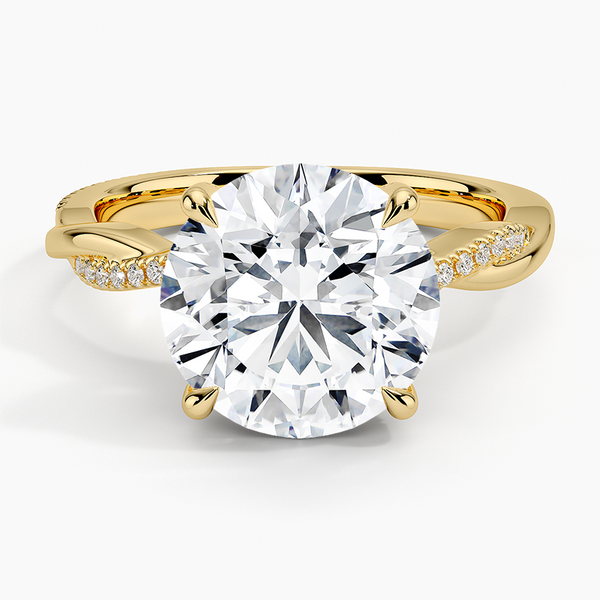
Petite Twisted Vine Hidden Halo Pavé Diamond Engagement Ring
$1,684.00

Waverly Hidden Halo Diamond Engagement Ring
$1,914.00

Viviana Three-Quarter Coverage Diamond Engagement Ring
$2,002.00

Viviana Half Coverage Diamond Engagement Ring
$1,684.00

Twisted Vine Hidden Halo Diamond Engagement Ring
$1,596.00

Tacori Sculpted Crescent Pear Diamond Engagement Ring
$3,851.00

Simply Tacori Luxe Drape Diamond Engagement Ring
$3,851.00

Sienna Half Coverage Hidden Accents Diamond Engagement Ring
$2,391.00

Secret Halo Diamond Engagement Ring
$1,507.00

Hidden Halo Eternity Diamond Engagement Ring
$1,949.00

Half Coverage Hidden Halo Diamond Engagement Ring
$1,649.00

Mixed Metal Viviana Half Coverage Diamond Engagement Ring
$1,596.00
Designing your ring
Designed online. Made by hand.
The convenience of online design.
-
Visualise it
Detailed CADs from every angle, so you see exactly what we’ll cast.
-
Try before we cast
Free ring sizers and a silver or wax sample to confirm the fit and feel before casting.
-
Hand-finished in London
Cast and finished in our London workshop and ready in 7–14 working days.
-
Risk-free
Every stone certified. Free refunds within 30 days (21 working) — no questions asked.
Three steps to your ring
-
1
Choose your starting point
-
2
Pair the two
-
3
We craft & deliver
