Solitaire Oval Engagement Rings
What defines a solitaire oval engagement ring?
A solitaire oval engagement ring holds a single oval-cut stone in a plain band with no shoulder stones, halos, or decorative side elements — the oval itself is the entire composition. This restraint is deliberate: the setting exists to lift and secure the stone, not to compete with it. The oval cut, developed in the early 1960s as a modification of the round brilliant, retains 57 or 58 facets and directs light through a longer, elliptical face. In solitaire form, that elongated outline sits uninterrupted against the skin, making the stone appear proportionally larger than a round of equivalent carat weight. The pairing of solitaire and oval is particularly suited to those who want maximum visual presence from a single stone without the added cost of surrounding diamonds.
How to choose the right oval for a solitaire setting
The most important decision in a solitaire oval ring is the stone's length-to-width ratio, as there is nothing else in the design to balance or conceal proportions. An oval with a ratio between 1.35 and 1.50 tends to read as classically elongated without appearing narrow; below 1.30 the outline approaches the round and loses the oval's defining stretch, while above 1.55 it can appear thin on shorter fingers. Alongside ratio, evaluate the bow-tie effect — a shadow across the centre facets present in most ovals to some degree. A well-cut solitaire oval will suppress the bow-tie to a faint, symmetrical shadow rather than a dark, distracting stripe. In terms of metal, platinum or gold both complement the oval solitaire; a four-claw or six-claw setting in either allows light into the pavilion from every angle, which sustains the cut's brilliance without interference from the band.
What does a solitaire oval engagement ring cost in the UK?
Price in a solitaire oval ring is driven almost entirely by the centre stone, since the setting itself — a plain band and a claw mount — adds comparatively little to the total. The oval's cost per carat sits slightly below that of a round brilliant of the same grade, because oval cutting produces less waste from the rough. A natural oval in the 0.75ct to 1.0ct range with mid-tier colour and clarity will cover a wide span depending on exact grading; a lab-grown oval of the same specification typically reduces stone cost considerably, freeing budget toward a higher carat weight or better colour grade without changing the solitaire design. Bridebook's US average engagement ring spend of $6,000 provides a useful baseline: a well-proportioned solitaire oval is achievable at or near that figure, particularly with a lab-grown stone.
How long does a made-to-order solitaire oval ring take?
A solitaire oval engagement ring is made to order in our Hatton Garden workshop, beginning with a CAD design produced after your initial consultation. From that design, a silver or wax sample is produced so the band profile and claw configuration can be assessed in person before anything is cast in the final metal. Once approved, the ring is cast, set with the oval stone, polished, and submitted for hallmarking at the London Assay Office. The full process runs to 7 to 14 business days from order confirmation — a straightforward solitaire with a standard band typically sits toward the shorter end of that range. Complimentary insured UK delivery is included, and the ring carries a lifetime warranty.
Caring for a solitaire oval ring in daily wear
Because a solitaire oval ring presents the stone without surrounding metalwork, the claws bear the full responsibility for securing the oval in place. Four-claw solitaire mounts are common and create a clean, open look, but six-claw settings offer an additional point of contact at each end of the oval — particularly worth considering given that the pointed tips of an oval are its most structurally exposed areas. In daily wear, platinum and 18ct gold both hold claws reliably; 9ct and 14ct gold are harder by composition and resist surface scratching, though they contain less fine metal by weight. It is worth having the claw tips checked annually regardless of metal choice, as the solitaire format means any loosening of the stone is immediately visible. Ultrasonic cleaning is generally safe for diamond solitaire ovals, but should be used with care if the centre stone is a gemstone — a sapphire, emerald, or ruby may have different tolerances.
Frequently asked questions
What is a solitaire oval engagement ring?
A solitaire oval engagement ring features a single oval-cut stone held in a claw mount on a plain band, with no side stones or additional diamond work. The design focuses entirely on the oval's elongated outline and its 57 or 58 facets. It is one of the cleaner, more restrained setting styles available, and suits those who want the stone to carry the visual weight of the ring entirely on its own.
Does an oval cut look bigger than a round in a solitaire setting?
Yes, in most cases. An oval stone's elongated face covers more surface area than a round of the same carat weight, because the oval's mass is distributed across a longer, shallower outline. In a solitaire setting — where nothing surrounds the stone — this effect is particularly pronounced. A 1.0ct oval will typically read larger on the finger than a 1.0ct round in a comparable mount.
What length-to-width ratio is best for a solitaire oval ring?
A ratio between 1.35 and 1.50 is generally considered the most balanced for a solitaire oval: elongated enough to register clearly as oval without appearing thin. Ratios below 1.30 begin to resemble a round, losing the cut's defining character. Ratios above 1.55 can look narrow, especially on wider fingers. The right choice ultimately depends on the wearer's hand and personal preference for how elongated the stone appears.
Can I choose a lab-grown oval diamond for a solitaire setting?
Yes. Lab-grown oval diamonds are available and certified to the same standards — by GIA, IGI, or HRD — as natural stones. In a solitaire oval setting, a lab-grown stone of a higher carat weight or better colour grade is often achievable within the same budget as a smaller natural oval. President Jewellers takes a neutral position on both origins; the decision typically rests on whether long-term resale value or current specification per budget matters more.
Can I have a gemstone rather than a diamond as the centre stone?
Yes. The solitaire oval setting works well with a range of gemstone centres, including sapphires, rubies, and emeralds. Sapphires at Mohs 9 are particularly suited to daily wear in an oval solitaire. Emeralds, at Mohs 7.5 to 8, require slightly more care with claw selection to protect the stone's edges. All centre-stone options — diamond, fancy-colour diamond, or gemstone — are available to discuss during your consultation.
How much does a solitaire oval engagement ring cost in the UK?
A solitaire oval engagement ring's price is driven almost entirely by the centre stone, since the mounting itself adds modest cost. A 0.5ct G/VS natural oval in a platinum solitaire commonly sits in the $2,900 to $4,650 band; a 1ct centre extends to $7,300 to $11,900 with GIA, IGI or HRD certification. Lab grown oval centres at the same grade reduce centre stone cost by 60-80 per cent — a 1.5ct or 2ct lab grown oval solitaire is achievable within typical UK engagement ring budgets. Bridebook's US average engagement ring spend of $6,000 typically suits a solitaire oval at 0.5ct to 0.75ct natural, or 1ct+ lab grown, depending on grade and metal choice.
Why does a solitaire setting expose the bow-tie effect more than a halo?
The bow-tie effect in an oval diamond — a dark, butterfly-shaped shadow across the stone's centre — is most visible in a solitaire setting because nothing surrounds the stone to compete with or distract from the shadow. In a halo setting, the perimeter ring of accent diamonds introduces additional bright reflections at the edges, which optically reduces the prominence of the bow-tie. For solitaire ovals specifically, request video of the actual stone before purchase. A well-cut oval will show a faint, symmetrical shadow that's nearly invisible in motion; a poorly cut oval can show a dark central band that dominates the face-up view. The certificate's cut grade alone is not sufficient — visual confirmation matters most.
Featured solitaire oval engagement rings
Hand-selected pieces from the President Jewellers catalogue
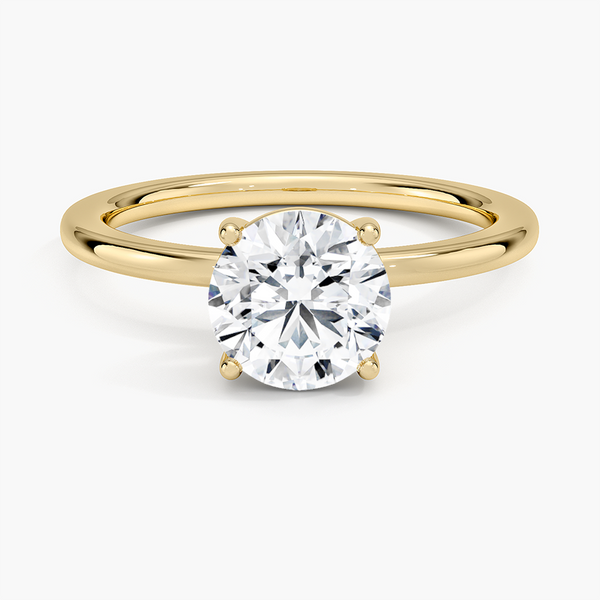
Solitaire Engagement Ring
$1,356.00

East West Tapered Baguette Diamond Engagement Ring
$1,557.00

Twisted Vine Solitaire Engagement Ring
$1,469.00

Simply Tacori Delicate Drape Diamond Engagement Ring
$2,785.00

Petal Solitaire Engagement Ring
$1,646.00

Manon Solitaire Engagement Ring
$1,416.00

Dara Low-Profile Solitaire Engagement Ring
$1,505.00

Comfort Fit Engagement Ring
$1,356.00

Budding Willow Solitaire Engagement Ring
$1,356.00

Aimee Solitaire Engagement Ring
$1,356.00

Adrian Solitaire Engagement Ring
$1,822.00

Provence Solitaire Engagement Ring
$1,593.00
Designing your ring
Designed online. Made by hand.
The convenience of online design.
-
Visualise it
Detailed CADs from every angle, so you see exactly what we’ll cast.
-
Try before we cast
Free ring sizers and a silver or wax sample to confirm the fit and feel before casting.
-
Hand-finished in London
Cast and finished in our London workshop and ready in 7–14 working days.
-
Risk-free
Every stone certified. Free refunds within 30 days (21 working) — no questions asked.
Three steps to your ring
-
1
Choose your starting point
-
2
Pair the two
-
3
We craft & deliver
