Red Lab Grown Fancy Diamonds
What makes a red lab grown diamond genuinely red?
A red lab grown diamond derives its colour from plastic deformation of the crystal lattice — the same mechanism responsible for red colour in natural diamonds — rather than from chemical impurities. This makes true red one of the hardest colour grades to produce intentionally, even under laboratory conditions. Most stones that emerge from the growth process with any red component are graded Fancy Brownish Red, Fancy Orangy Red, or Fancy Purplish Red by the certifying laboratory. Pure Fancy Red grades with no modifying descriptor are exceptionally scarce even among lab grown stones, and command a significant premium over other lab grown fancy colours. When evaluating a red lab grown diamond, the certification document — from GIA, HRD, or IGI — will state the precise colour grade and any modifying hue, which directly determines value.
How do red lab grown diamonds compare to natural red diamonds?
Natural red diamonds are among the rarest gemstones on earth, with only a handful of pure Fancy Red examples documented globally. Red lab grown diamonds share the same carbon crystal structure and identical physical properties, but are produced in a controlled environment using either HPHT or CVD growth methods, making them more accessible in terms of availability and price per carat. The colour origin — lattice defects rather than impurities — is the same in both natural and lab grown red diamonds, which is why red remains difficult to produce consistently in the laboratory. For buyers where long-term resale value is a priority, natural red diamonds hold a different market position; for buyers focused on acquiring a certified red diamond at a more accessible price point, lab grown is a practical route to a stone that is chemically and optically identical.
What settings and metals suit a red lab grown diamond?
A red lab grown diamond's warm, saturated hue is best supported by a setting that does not compete with or cool the colour. Rose gold — particularly 18ct rose gold — draws out the red and pink tones within the stone, while yellow gold provides a warm, complementary contrast. Platinum and 18ct white gold create a starker contrast that can make the red appear more vivid against a cool background, which suits deeper, more saturated stones. Bezel and four-claw solitaire settings are often favoured for red lab grown diamonds because they expose maximum surface area to light, allowing the colour to read clearly. Halo settings can be effective if the surrounding stones are white diamonds, which frame and intensify the centre colour without adding competing hue. When a loose red lab grown diamond is set into one of our rings, the full made-to-order process applies, with a CAD design, silver or wax sample try-on at our Hatton Garden workshop, and a lead time of 7–14 business days from order confirmation.
What does a red lab grown diamond cost in the UK?
Red lab grown diamonds are priced at a premium relative to other lab grown fancy colours because true red colour yield from growth processes is low and unpredictable. Price is driven by the precise colour grade — pure Fancy Red commands more than Fancy Brownish Red or Fancy Orangy Red — as well as carat weight, clarity, and cut quality as recorded on the GIA, HRD, or IGI certificate. Lab grown red diamonds are nonetheless considerably more accessible than their natural equivalents, making them a practical choice for buyers seeking a certified red stone. Bridebook's US average engagement ring spend of $6,000 provides a useful market reference point, though red fancy colour stones typically sit above that figure even in smaller carat weights.
Caring for a red lab grown diamond
Red lab grown diamonds share the hardness of all diamonds — 10 on the Mohs scale — making them highly resistant to scratching in everyday wear. The colour in a red lab grown diamond is a structural property of the crystal lattice and does not fade, bleach, or change with exposure to light, heat, or cleaning agents under normal conditions. Ultrasonic cleaning is generally safe for red lab grown diamonds set in plain solitaire or bezel settings, though stones set with pavé shoulders or intricate metalwork should be cleaned with a soft brush and warm soapy water to avoid loosening smaller accent stones. All President Jewellers settings carry a lifetime warranty, and resizing is free for life.
Frequently asked questions
Are red lab grown diamonds real diamonds?
Yes. Red lab grown diamonds are chemically, physically, and optically identical to natural diamonds. They are composed of pure carbon in a cubic crystal structure, score 10 on the Mohs hardness scale, and are graded and certified by GIA, HRD, or IGI using the same colour and quality criteria applied to natural stones. The only difference is their origin: a controlled laboratory environment rather than the earth.
Why are red lab grown diamonds so rare even in a laboratory?
Red colour in diamonds arises from plastic deformation of the crystal lattice, not from chemical impurities, and this structural distortion cannot be reliably induced during the growth process. Most growth runs produce colourless, near-colourless, or yellow-tinted stones. Red colour outcomes are unpredictable, which means true Fancy Red grades remain scarce even among lab grown production, and stones with modifying hues such as brownish or orangy red are more commonly available than pure red.
Which certifying bodies grade red lab grown diamonds?
President Jewellers supplies red lab grown diamonds certified by GIA, HRD, or IGI. Each certificate records the precise colour grade — including any modifying descriptor such as Fancy Orangy Red or Fancy Purplish Red — alongside clarity, cut, and carat weight. The certification document is the authoritative record of the stone's colour classification and should be requested for any red fancy diamond purchase.
Can a red lab grown diamond be set into a bespoke ring?
Yes. Any loose red lab grown diamond from our collection can be set into a made-to-order ring. The process begins with a consultation and CAD design, followed by a silver or wax sample try-on at our Hatton Garden workshop. From order confirmation, the lead time is 7–14 business days depending on setting complexity. The finished ring is hallmarked at the London Assay Office and delivered with insured Free US delivery over $200.
What is the return policy on red lab grown diamonds?
Loose red lab grown diamonds purchased from President Jewellers carry a 30-day return period with no exclusions. Once a loose stone has been set into a ring, the made-to-order ring returns policy applies — 30 days, with custom and bespoke orders excluded. Returns and delivery queries can be directed to the team at our Hatton Garden workshop.
How much does a red lab grown diamond cost in the UK?
Red lab grown diamond pricing in the UK is driven by colour intensity and the presence of any modifying hue. A Fancy Brownish Red or Fancy Orangy Red lab grown at 1ct commonly sits in the $1,050 to $2,650 range with GIA, IGI or HRD certification. Pure Fancy Red lab grown stones — without any modifying descriptor — are exceptionally rare even in laboratory production and command a meaningful premium, often $3,950 to $7,950 per carat. By comparison, natural pure Fancy Red diamonds frequently exceed $1,324,700 per carat at auction; lab grown origin makes the colour grade accessible at all, where natural is effectively unreachable for most buyers.
Why is red the hardest colour to produce in a lab grown diamond?
Red colour in any diamond — natural or lab grown — arises from plastic deformation of the crystal lattice rather than from chemical impurities. In a controlled laboratory environment, growers can deliberately introduce nitrogen (for yellow) or boron (for blue), but the structural distortion required for pure red cannot be reliably induced during growth. Most lab grown attempts at red produce Fancy Pink, Fancy Purplish Red, or Fancy Brownish Red instead — pure red yields are unpredictable, which is why true Fancy Red grades remain scarce even with laboratory production capabilities far exceeding mining.
Featured red lab grown fancy diamonds
Hand-selected pieces from the President Jewellers catalogue
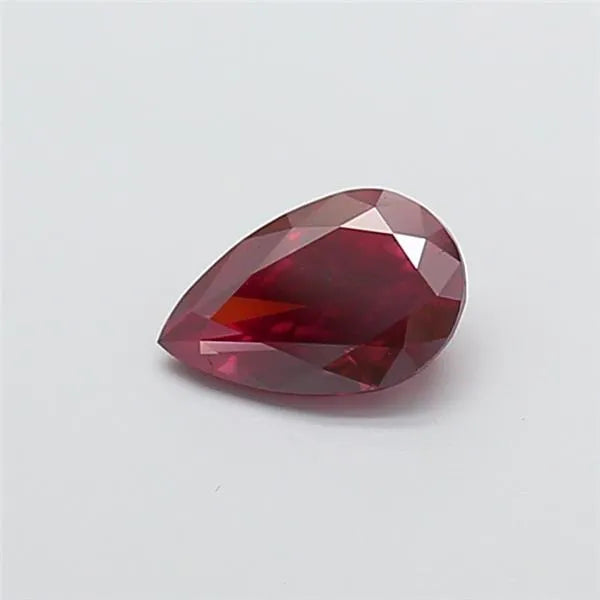
Loose & certified
Looking to pair it with a ring?
Every diamond on this page is loose — buy it on its own, set it into a ring of your own design, or pair it with one of our settings. Open any stone, click Set in a ring, and we’ll take you to your engagement, eternity or wedding band options.
Already have a setting in mind? Tap the menu icon and choose Engagement Rings › Ring Builder.
