-
Engagement ringsWedding ringsEternity ringsDiamondsGemstones
Ruby Gemstones
What is a ruby gemstone and what gives it its colour?
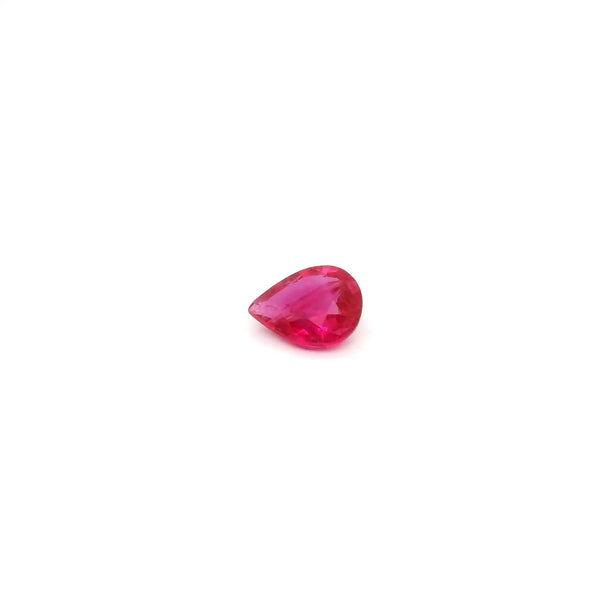
A ruby is the red variety of corundum (aluminium oxide), coloured by trace amounts of chromium — the same element responsible for the stone's characteristic fluorescence under ultraviolet light. Corundum in any other colour is classified as sapphire, so the red of chromium is what defines a ruby entirely. The most sought-after hue is described in the trade as 'pigeon-blood' — a vivid, slightly bluish-red with strong saturation and minimal brown or orange secondary tones. Rubies from Myanmar (formerly Burma), particularly the Mogok Valley, have historically set the benchmark for this colour. Stones from Mozambique, Thailand, and Madagascar are also widely traded, each with their own subtle colour character. A fine ruby's chromium content also causes it to fluoresce red under UV light, which can intensify the apparent colour in sunlight — a property no other red gemstone replicates to the same degree.
How to choose a ruby gemstone: colour, clarity, and cut
When selecting a ruby, colour is the dominant quality factor — more so than in diamonds, where cut and clarity carry comparable weight. For a ruby, saturation and hue take precedence: a vivid, evenly distributed red will outperform a heavily included stone of the same carat weight at every price point. Clarity in rubies is assessed differently from diamonds. Almost all natural rubies contain inclusions, often described as 'silk' — fine rutile needles that can actually enhance the stone's identity and, in some cases, its value. An eye-clean ruby of strong colour is considered exceptional. Cut affects how well the colour is distributed across the face of the stone: a well-proportioned ruby should show consistent hue across the table with no extinction (dark, lifeless areas) at the centre. Oval and cushion cuts are particularly common in rubies because they retain carat weight while maximising colour depth. Calibrated round rubies are frequently used in pavé or eternity settings.
What does a ruby gemstone cost in the UK?
Ruby pricing is driven primarily by colour, origin, treatment status, and carat weight — with fine, unheated Burmese rubies commanding the highest premiums of any coloured gemstone per carat. Heat treatment is standard in the trade: it removes silk inclusions and improves colour, and treated rubies are far more accessible in price than unheated equivalents of comparable colour. A treated ruby of good colour and modest carat weight sits at a lower price point than an equivalent diamond, while an unheated pigeon-blood ruby can exceed fine diamond values per carat. Origin certification — confirming Burmese provenance — significantly increases value for investment-grade stones. For those setting a ruby into a ring rather than buying for collection purposes, a well-chosen treated stone of vivid colour will deliver a far more visually impactful result per budget than an unheated stone with compromised colour. According to Bridebook's US average engagement ring spend of $6,000 coloured-stone rings — including ruby — are a growing category among couples seeking an alternative to the traditional diamond solitaire.
Is a ruby durable enough for daily wear?
Ruby rates 9 on the Mohs hardness scale, second only to diamond at 10, making it one of the most durable gemstones available for everyday settings. This hardness means a ruby resists surface scratching from contact with most common materials, including other gemstones except diamond. However, hardness and toughness are not the same property. Rubies can contain internal fractures or feather inclusions that reduce their resistance to impact, particularly if the stone has been fracture-filled (a lower-grade treatment involving glass or resin). When purchasing a ruby for a ring, the treatment status disclosed on its certificate matters: heat-treated-only rubies are stable and require no special care beyond standard cleaning, while fracture-filled stones should be kept away from ultrasonic cleaners and steam. For a ring worn daily — particularly in a bezel or low-profile setting — a ruby of good clarity and documented treatment status is a well-suited choice. When set into one of our rings, the finished piece is hallmarked at the London Assay Office.
How are President Jewellers' ruby gemstones sourced and certified?
Every ruby in our inventory is sourced through ethical-mine partner suppliers with documented provenance trails. Rubies are available with gemological grading reports where issued — principally from recognised gemological laboratories — or with a certificate of authenticity confirming species, colour, and treatment status. Treatment disclosure is provided for every stone: heat treatment, fracture-filling, or unheated status is stated on documentation rather than left to assumption. When a loose ruby is selected for setting into one of our rings, the process moves to CAD design, a silver or wax sample for review at our Hatton Garden workshop, casting, setting, and finishing — with a lead time of 7-14 business days from order confirmation. Loose ruby purchases carry a 30-day return period, no questions, no exclusions, with complimentary insured UK delivery on every order.
Frequently asked questions
Where can I buy a ruby gemstone in the UK?
Ruby gemstones can be purchased loose through President Jewellers, either to keep as a stone or to set into a ring. Each ruby is sourced through ethical-mine partner suppliers and supplied with a grading report or certificate of authenticity. Orders are delivered with complimentary insured UK shipping, and a 30-day return period applies with no exclusions.
What is the difference between a treated and untreated ruby?
Heat treatment is applied to the majority of commercial rubies to improve colour and reduce the visibility of silk inclusions. It is a stable, industry-standard process and does not affect durability. Unheated rubies of equivalent colour are significantly rarer and command considerably higher prices per carat. Treatment status is always disclosed on the ruby's accompanying documentation.
What carat weight ruby should I choose for a ring setting?
For a solitaire or centre-stone setting, rubies between 0.5ct and 1.5ct offer a practical balance of visual presence and budget. Rubies are denser than diamonds, so a 1ct ruby will appear slightly smaller face-up than a 1ct diamond of equivalent proportions. Oval and cushion cuts tend to maximise face-up size per carat weight in ruby more than other shapes.
Are rubies a good alternative to diamonds in an engagement ring?
A ruby rated 9 on the Mohs scale is durable enough for a ring worn daily. Its deep red colour is among the most distinctive of any gemstone. Whether a ruby suits a particular ring depends on personal preference, the chosen setting style, and metal — yellow or rose gold tends to warm the red, while white gold or platinum offers contrast. All three options are available when setting a ruby through President Jewellers.
How do I care for a ruby gemstone ring?
For heat-treated-only rubies, warm soapy water and a soft brush are sufficient for routine cleaning. Avoid ultrasonic or steam cleaning if the stone's treatment status is uncertain or if it has been fracture-filled, as these processes can damage filled inclusions. Store the ring separately from diamond jewellery to avoid surface contact, and have the setting checked periodically to ensure the stone is secure.
Featured ruby gemstones
Hand-selected pieces from the President Jewellers catalogue
You might also like
Related collections and pages from President Jewellers
Loose & certified
Looking to pair it with a ring?
Every gemstone on this page is loose — buy it on its own, set it into a ring of your own design, or pair it with one of our settings. Open any stone, click Set in a ring, and we’ll take you to your engagement, dress or cocktail ring options.
Already have a setting in mind? Tap the menu icon and choose Engagement Rings › Ring Builder.
What our customers say
From your first question to your finished ring — our Hatton Garden specialists are here throughout. Crafted for your forever.
From your first question to your finished ring — our Hatton Garden specialists are here throughout. Crafted for your forever.
